Wealth of writers


writing_in_notepad

As I listened to the local authors read from their works in 27 Views of Charlotte, I was overwhelmed by the wealth of talent in my adopted region. We had gathered at Park Road Books last Saturday for the book launch. I was there to support several friends whose pieces are included and to pick up a copy as a gift. However, the event became a celebration not just of the book or the city it profiles in poetry and prose, but of Charlotte-area writers, those represented in the volume and those who are not.

My friend Jack Claiborne, who wrote the preface and is author of a number of historical books on the region, explained that decades ago, Charlotte’s writing community was a small one. He said that today it has burgeoned and the voices being heard are as diverse as the region’s increasingly eclectic population.

I have written before about the value – no, the critical importance – of being part of a writers community. Mignon Ballard, author of the Augusta Goodnight mystery series and 13 other books, triple underscored that point to Saturday’s group. She wrote in 27 Views how winning a Charlotte Writers’ Club short story contest gave her much-needed confidence and led to her first published book. Through the Charlotte Writers’ Club, she connected with other fledgling and successful writers who offered each other clear-eyed, constructive criticism. Within this group, Mignon writes, “I was at last among people who not only loved the craft as I did, but were seriously intent on developing those skills.”

As the authors mingled with book buyers after the presentation, signing each others’ paperbacks, it felt like a family reunion. An important part of that family was the one hosting the party. Park Road Books, the city’s only independent new book seller, is an integral and supportive part of our literary community.

I have some acquaintances that do not frequent the independent bookstores in their communities and others whose only collaboration with writers is online. For me – and for many of the authors in 27 Views, that just doesn’t hit the mark. Nothing is more essential to my development as a writer than meeting face-to-face with others in my profession and the people who will be selling my books.

I plan to stay in touch with some of those that I met on Saturday and add them to my ever widening circle of support.


Posted in My posts | Tagged , , , , , , , , , , , | Leave a comment

Sticks and stones


Pen Mightier than SwordWe all know the power of words. They have incited revolutions, won and lost elections, galvanized movements, and begun and ended relationships. They have the power to cause incalculable harm and to bring restorative peace.

Last week, Ken Burns’ wonderful PBS series, “The Roosevelts,” reminded me of the importance of word choice. Whereas Herbert Hoover called the banks closures he ordered a “moratorium,” Franklin Roosevelt called his closures a bank “holiday.” Further, he said hoarding money had become “unfashionable.” Wanting to be neither party poopers nor unfashionable, many people heeded his call to redeposit their money when the holiday was over. Although Americans had far more to fear than “fear itself,” Roosevelt’s choice of words helped halt the Depression’s slide and provided hope around which citizens could rally during  the country’s long and painful economic recovery and second World War.

It’s ironic that we are not taught words’ power as children. Rather we learn that “sticks and stones may break my bones, but words will never hurt me,” even as we know from first-hand experience that this bromide is not true.

Edward Bulwer-Lytton wrote in his 1839 play Richelieu; or, The Conspiracy, “The pen is mightier than the sword.” It was a truism that had been written in various forms for centuries and probably repeated verbally since language began.

As writers, we are taught to make each word count. Poets, in particular, are skillful at packing a punch within a tightly defined space. Good writers in all genres characterize, elicit emotions and convey images with a single word. We learn what a character is like when a smile is a grin or a smirk.

Our skills as writers give us the power not only to entertain, but to educate, wound and heal. We can help people heal by encouraging them to find their own words. We can educate or inform through prose and poetry. We can provide escape or catharsis by immersing our readers in lives and places apart from their own.

Most important is the effect we can have on the people with whom we come into contact each day. By taking the same care with our spoken words as we do with our written ones, we have the power to make our personal worlds a little better.

Posted in My posts | Tagged , , , , , , , , | 2 Comments

Heeeeere’s…..Father Francis!


priest_holdingup_chalice_redPoor Father Francis. Originally the opener, he’s been relegated to back-up player.

Let me explain.

I created Father Francis to provide an insider’s view of Clinton from an outsider’s perspective. Who better than a priest to know everything that’s going on without actually being involved. He was my fly on the wall.

But as I started writing, I became enthralled with him. My narrative shifted from his observations to mine on who the man is. His family, his early years as a priest and his mentor – all in there. As he came alive, I found out how he had changed in the 20 years between his first and second assignments to the parish. There was only one small problem. Most of this had nothing to do with the story. So, after a gentle nudge from a colleague, I cut Father Francis down to size.

I moved him from the first chapter to the second. But he didn’t fit there. So, I moved him to the third. Then the fourth. I pushed him to the fifth, then the sixth chapter. Not only did he not fit into the town, he didn’t fit into the book, at least not so far.

So, here I am on chapter seven, and Father Francis finally is ready for prime time. However, the priest is a shadow of his former self. I made liberal use of the delete key and focused on Francis’ raison d’être. His family background – gone. His mentor – a mention. Pages on his first assignment in Clinton – deleted. Descriptions of the church and rectory – truncated.

And then there’s Paul. In the chapter’s first iteration, Paul was barely a blip in the priest’s mind. Yet it is Janelle’s search for the essence of Paul that is at the heart of the book and her reason for interviewing Father Francis. So, in chapter seven, Paul drifts in and out of the priest’s thoughts as he struggles with what he knows, what he thinks and what he should say about both.

I have a secret, though. I didn’t really delete Father Francis’ back story. I cut and pasted it into a separate document. It doesn’t fit in this book, but I might resurrect it in a future one where Father Francis is more at home.

Posted in My posts | Tagged , , , , | 1 Comment

The lonely profession


woman typingIt gets lonely out here.

Writing, by its very nature, requires us to work alone. Even those of us working in corporations, nonprofits and academic institutions have to shut ourselves off from our colleagues to do our jobs. Those of us doing contract, freelance or independent work, writing our own poetry and prose are even more isolated. Interruptions are sabotage, stealing precious time or even more precious thoughts or words.

After agonizing hours, days or weeks, we present our products to those paying us to write them. Feedback tends to run in three veins: Great. Thanks. This misses the mark. Unless we’re very fortunate, we rarely have access to peer review, other writers who can provide guidance on how to express our thoughts better.

Writers are no different from athletes. Serena Williams didn’t start winning tournaments just by returning balls she hit against backboards. She discovered and refined her style by practicing, getting great coaching and learning from other outstanding players. To improve and find our unique voices as writers, we need both practice and feedback from editors and other writers.

Workshops and conferences can be valuable, but these once- or twice-a-year avenues aren’t enough. I’ve written before about how invaluable I find my critique group peer feedback. I adopt and adapt some of their suggestions as I hone my skills and find my rhythm.

Critique groups provide hard looks and constructive comments that writers need. But we need more. Through online or in-person groups like the 92-year-old Charlotte Writers’ Club, writers can solicit general input in more casual settings than critique groups often provide.

Both critique groups and writing communities offer something that writers get nowhere else: the sense that we aren’t alone. There are a whole lot of writers out there. Writing communities validate what we do. We discover that every writer, at one time or another, has looked at untold hours’ worth of their work as worthless drivel. Some of it is. Writing communities help give us the courage to hit delete and start again, confident that we are not alone.

Posted in My posts | Tagged , , , , , , | 4 Comments

The work of writing


computer keysWriting is both a labor of love and a lot of work. A Charlotte Writers’ Club author said in a recent club newsletter that the more time she allows to elapse between writing sessions, the harder it is for her to sit down and write.

That is so true for me, too. When I write daily, I’m more engaged with my story. As I drive, I think about what my characters will do next. I rethink plot points as I work in the yard or do laundry. And my showers stretch out way too long, as I mentally rearrange events, sharpen dialogue, add tension to interactions and generally fine tune my story.

Yet, it is so easy to give myself a pass and take a few days off. The later it gets in the day, the more writing becomes a chore and the easier it is to find excuses. The batteries in the smoke detector need to be changed. The weeds are out of control. My car is past time for an oil change. My “down” time becomes filled with more acceptable chores that are a lot less mental work.

I need to write right after an early breakfast or around noon. After dinner, my brain’s first shift has gone home. By 9 p.m., the night shift has taken over. Enough said.

For every five days in a week that I meet or exceed my self-imposed daily word count, I give myself two days off. Those days, I don’t write unless I feel like it, but I keep thinking. Jotting down notes or leaving myself messages keep the creative juices flowing and make me eager to incorporate my brilliant ideas when my hiatus is over – or before!

So this Labor Day is not a day off. I’m at my computer, writing about Janelle’s doubts, her fight with her boss and what Paul’s friends tell the reporter. None of this might turn out like I imagined, but I won’t know until I start writing. And I can hardly wait to find out.

Posted in My posts | Tagged , , , , , | 2 Comments

Ramping up the tension


tensionSome people thrive on conflict. I am not one of them. Actual and imagined confrontations leave my stomach in knots. Although conflict avoidance can make the real world more pleasant, it is the kiss of death in fiction, which requires tension and a story arc to keep readers turning pages. This is a problem for me, as I find myself instinctively wanting my key characters to face only the most minor inconveniences.

Boring.

Five chapters into my book, I’m discovering that the most interesting characters are the minor ones struggling with internal conflicts. Hmmm. Time to revise and throw some roadblocks in front of my major character.

Now, instead of having two weeks to research and write her story, Janelle has one. But she’s running out of time and has learned no more about why Paul, the accused hometown bioterrorist, carried out the attacks than she knew before she arrived in Clinton. However, she’s discovering that in spite of the evidence, a lot of people think he’s been made the fall guy, so the case can be closed quickly. She’s also finding out that no one really knows Paul – at least so far.

She has to go back to her editor and beg for another week. She doesn’t have a story and needs the extra time to see what she can learn. She gets it, but her job is on the line. How much of what people tell Janelle can she take at face value? The reader knows; can she figure it out?

As my story progresses, I’m constantly rethinking the plot. Already minor characters play larger roles than I’d originally envisioned. Since my plots are character-driven, their layers of complexity impact how I write about their interactions with those around them. Too often, I become so fascinated with these people of my imagination and their internal conflicts that I write into the weeds. I have to control my impulse of making understanding them the end, rather than the means of moving the plot forward. Last week, I deleted about 2,500 words that gave way too much irrelevant information about one of them. This week, I’ll reluctantly go back and kill my darlings – sentences and paragraphs I really, really like but are inconsequential in the scheme of things.

So, it’s back to my oft-changed outline to insert some conflict and raise the tension. I don’t think Janelle will thank me for it, but my readers will.

Posted in My posts | Tagged , , , , , , , , | Leave a comment

Endings


TheEndAh, the possibilities of beginnings!  Smorgasbords of plot potential and crackling climaxes. Endings? Necessary evils – often awkwardly awful termini, wrap-ups rushed like the “Sixty Minutes’” second hand ticking to the hour’s end.

Endings tend to be as problematic in books as they are in life. However, Tom Vanderbilt writes in “Inconclusion” that good final lines are satisfactorily unending, just as good openings should be merely books’ starting points. In well-written fiction, readers should want to know what happened before we wandered into the story and what happens when we leave. The New York Times Magazine article notes that we writers spend endless time crafting our openings. I rewrote the beginning of this post at least a half dozen times. As examples, Vanderbilt quotes some memorable first lines easily identified with oft-read books.

Final lines don’t fare as well. In an end-of-article quiz matching last lines to five well-known books, I scored abysmally, and I suspect I wasn’t the only one. Vanderbilt suggests several reasons why we tend to be better at beginnings than endings, whether making a good first impression on a date or catching readers’ attention to keep them reading.

As important as openings are, endings are no less important. Countless times, I have read good books only to be disappointed in what seemed to be slap-shot finales. It’s as if the authors had lost interest and had dashed off an ending, so they could move on. Having invested my time in the stories and my emotions in the characters, abrupt and unsatisfying conclusions leave a bad taste in my mouth, negating the good writing that went before.

I admit I’m an offender, having written bad endings more times than I’d like to admit. I’ve finished an article or story and am faced with the dreaded need to conclude. There’s always the fall-back cliché, ending with a quote. But in doing that or writing a final sentence that neatly wraps things up or makes a point, I feel twinges of guilt, like I’m cheating, taking the lazy writer’s way out. It’s what Vanderbilt calls “a Lunchables of the mind,” compressing “a tangle of ideas into some little container.” To do so, he says, is to fail the reader and to fail as a writer.

Rather, Vanderbilt says to consider every ending as a potential beginning. Not in callous anticipation of a sequel, but as a hallmark of good writing. Only then will our characters and places live on in the imaginations of our readers.

Posted in My posts | Tagged , , , , , , , | 1 Comment

Departure


Mark with cycle silhoutte RIP-edDark clouds on my horizon creep in with summer’s heat.

Weighing me down, making me sluggish,

Like July’s humidity.


Encompassing blackness looms inexorably closer.

Dragging my soul, consuming my thoughts,

As oppressive as August.


Hatless officers sowed seeds for this Stygian vortex.

Bringing a wallet, leaving no doubt,

As clear as the license.


Denial does not fend off Augusts’ cataclysm.

Stinging my eyes, pelting my heart,

As shattered as his iPod.


Empty darkness lingers long after the storm abates.

Holding memories, bringing solace,

Like the end of a flash flood.


Thirty-four gifts are a bittersweet legacy.

Flooding 10 states, rebuilding some lives,

Like gold at a rainbow’s end.

Posted in My posts, Random writings | Tagged , , , | 1 Comment

Feast of words


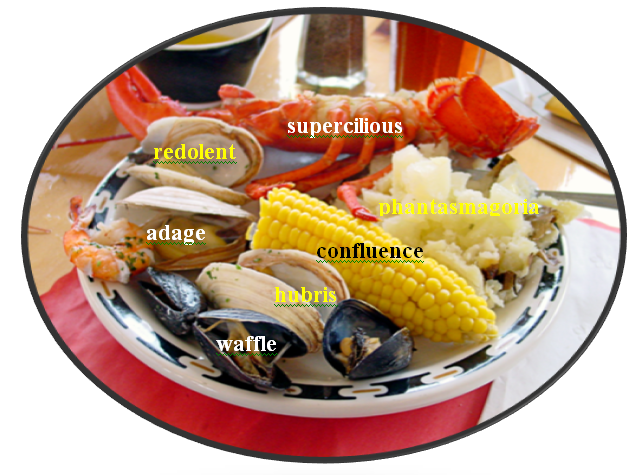
feastI love the sensory sensuality of words. All those anticipatory Ts standing at parade rest in attentive. That D bumping into the G in nudge. Euphoria just dares those outnumbered consonants to hold down its vowels. And there’s something inherently sinister and furtive in the eliding consonants of slither. My favorite part of studying Hawaii’s history in school was not the exotic royalty, but being able to say King Kamehameha and Queen Liliuokalani out loud. Mahalo even sounded welcoming. All those vowels turned each Hawaiian word into a song.

I savor the flavors that roll around in my mouth as I taste nibble and imbibe. All those round Os and Gs in gorge leave me satiated. Whereas one word is a meal, multiples are two-scoop treats. The alliterative frisky feline is fun, but the consonance coupled with onomatopoeia (a delightful word in itself) of the hissing snake doubles the pleasure each word offers standing on its own. Similes and metaphors add additional layers and depth.

In high school, my friends used to say that I’d pull obscure words from the air, blow the dust off and insert them into my sentences. That always puzzled me. We writers search our memory banks for that perfect word to express what we are trying to convey. Just scroll down the dozens of synonyms in a thesaurus for say, and I rest my case. Retort and state both convey saying something, but they have vastly different meanings. Other differences between synonyms can be more nuanced, and it is the writer’s job to choose just the right word.

Poets are well versed (pardon the pun) in verbal efficiency. The paucity of space necessitates language redolent with imagery. The first 30 words of Charlotte poet David Radavich’s poem “Caveat” offers an economy with a rich return:  “Be careful what/you let into your head./It may take root/there, send shoots through/the system,/leaf into your soul/and then shed/all into the winter wale.”

Writers play with words, creating combinations with which we become enamored. We so love our darlings that we often insert them into our work, whether they belong or not. However, as good writers we must sometimes kill our darlings, heeding that oft-quoted, sage advice that can be traced back to Arthur Quiller-Couch’s 1913-1914 Cambridge lecture “On the Art of Writing.” But our darlings are not truly dead. We enshroud, entomb, then resurrect and breathe new life into them when we create a more suitable medium.

Our words create feasts not only for our own souls, but for those of kindred spirits. So, writers, let’s cultivate our craft that we might feed the world.

Posted in My posts | Tagged , , , , | Leave a comment

In defense of failure


star,moonThe author of a recent New York Times opinion piece postulated that writers are “the real professionals” when it comes to failure. To support his premise, Stephen Merche ticks off writers such as Fitz-Greene Halleck, widely praised in their own times and all but forgotten today, as well as those such as John Keats, whose work is celebrated now but died failures. He points out that for every big-name writer, there are hundreds of thousands more whose names are unknown. Some remain in well-deserved obscurity, but others have penned works that sing.

Merche notes that of the approximately 300,000 books published annually in the U.S. alone, not more than a few hundred achieve any measure of success creatively or financially. However, far from being depressing, “Failure Is Our Muse” gives us writers cause for hope. A novelist himself, Merche says that writers excel at more than failure. We are exceptionally good at persisting in the face of failure. All this unsung writing creates what he calls a “subterranean richness,” hidden treasures that readers delight in finding. It’s a trove he says that The New York Review of Books series continually mines, and it’s a lode that never will peter out.

Merche includes a quote from Gustave Flaubert that resonated with me: “Human speech is like a cracked kettle on which we tap crude rhythms for bears to dance to, while we long to make music that will melt the stars.” More often than not, our results do not reach beyond the mundane, yet we keep trying. We experience outsized satisfaction when we succeed in molding ordinary words into extraordinary prose and poetry. We write against the odds, hoping to gain critical recognition and financial rewards. But that is not primarily why most of us write. We write because we have a vision. As we continually hone our skills, we hope that one day our words will melt the stars.

Posted in My posts | Tagged , , , , , , , , , , | 2 Comments